Birdathon 2013

OLYMPUS DIGITAL CAMERA

We hoped for a “ducky” day!

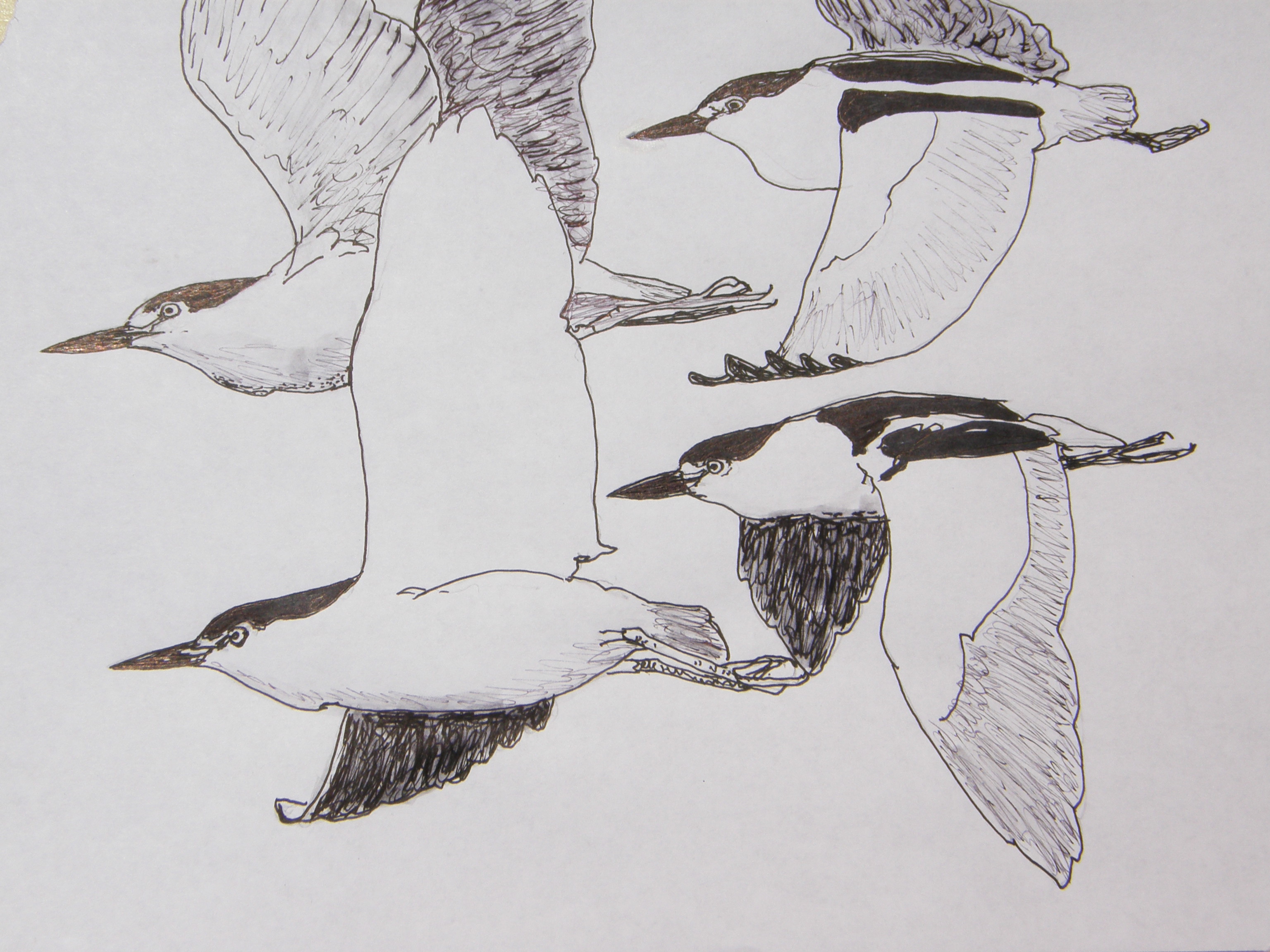
Sunday, May 5, was our ANS Birdathon day for Diane Ford and me.  Diane is a birder and a bird artist; she did these sketches. Thanks, Diane!

By the time Diane got to my house at 7:30, I had 17 bird species on my backyard list. She added the ones she’d seen or heard as she was driving through Rock Creek Park, which brought us to 32. The weather forecast was for a partly cloudy day, highs in the mid-60s—a good day for birding, but cool for this time of year.

We knew I’d be doing less walking this year because of my bad knee. We tried to “bird smarter”: we’d make every birding site do its best and then we’d be back in the car.

Our first stop was Aspen Hill Park, whose trail along Rock Creek was popular early—several gaggles of runners passed us. The song of a Common Yellowthroat cheered us with a promise of other warblers. In turn, we cheered a newly arrived Yellow-throated Vireo singing his lazy song in a creek-side sycamore. The sibilant calls of Blue-gray Gnatcatchers attracted our attention, and Diane found their lovely lichen-decorated nest.

OLYMPUS DIGITAL CAMERA

Osprey and prey

Diane left the path to investigate an interesting song. When she returned, I pulled out my cell phone with Sibley’s birding app, and she confirmed that it was a Blue-headed Vireo. There are times when technology is really great.

Next stop: Lake Needwood. As I was parking by the Visitor Center, “Ooh!” said Diane and took off as soon as the wheels stopped. Ah, an Osprey! The beautiful big bird perched on a bare branch above the lake, eating a fish and fending off pesky crows.

We wasted some time trying to pull a non-existent Worm-eating Warbler out of a flock of Yellow-rumps, but did get a Chipping Sparrow, Barn Swallow and Eastern Bluebird from the dam area. Then it was time for the pause that refreshes. This was lucky, as near the porta-potty we heard a special bird—a Scarlet Tanager. He was very close. We pursued, and Diane got him in her scope. Oh, my, he was spectacular. “A maraschino cherry,” Diane pronounced.

OLYMPUS DIGITAL CAMERA

Scarlet Tanager

The water in the “five finger” end of the lake was too deep for shorebirds this year, but we did find our usual Northern Rough-winged Swallows. A tradition upheld.

Now for Blue Mash. We were met in the lot at 10:50 am by a burst of song from a Common Yellowthroat.  As if they and the Yellow Warblers we found nearby had contrived to challenge the sun, its orb finally broke through the clouds. Tree Swallows were calling, flying, and mating; the first Turkey Vulture was up, and the warming air brought forth the scent of honeysuckle.

The big pond was a washout, so to speak, so Diane went on through the park to the small pond while I returned to the car to rest my knee and keep my ears open. In this “divide and conquer” mode, we texted each other with our discoveries, and had to laugh when simultaneous texts reported White-eyed Vireo on both sides of the park.

We made our usual stop in Olney for drinks, a tick check, and a recount. As we headed out to the western part of the county, our total stood at 63 species, only three less than in 2010, our record-setting year (90 species total).

OLYMPUS DIGITAL CAMERA

Five-lined Skink

I pulled into the Riley’s Lock parking lot at 1:30. The day had become lovely and warm; we grabbed our lunches and joined the other people enjoying the outdoors. We spent our first ten minutes watching five-lined skinks and a big black rat snake along with the little boys who were fishing in Seneca Creek.

OLYMPUS DIGITAL CAMERA

Prothonotary Warbler

We had barely started on our sandwiches when a loud SWEET SWEET  SWEET rang out from the turning basin—a male Prothonotary Warbler was calling us. Well, not us, exactly, but we ran anyway, and there he was, golden yellow and gorgeous, singing near his nesting box. He was one of our target birds for this part of the canal, so we were thrilled. We crammed in some lunch and started walking the towpath; a bullfrog called his deep notes, turtles were basking, and sweet cicely (no relation) was blooming. Three more Prothonotaries sang—it was a very good year for Prothonotaries!

OLYMPUS DIGITAL CAMERA

Mama Wood Duck and family

We walked and walked, but couldn’t find any Wood Ducks, either, though I’d seen some there just a few days before. I was achy and ready to turn back, but some fellow birders rode up on their bikes and said they’d seen Wood Ducks farther along the canal, a female with eleven babies. “Eleven babies!” I said, and the aches diminished right away. Of course we had to find that family, and fast. The scene we found was worth every step. The calm and lovely mama duck swimming amid her eleven (yes!) fluffy little ducklings was such a sweet sight.

And our extra walk was rewarded further by an elusive song that we struggled to identify. Tentatively we decided it was not a Louisiana Waterthrush but a Yellow-throated Warbler, tried the Sibley songs on my cell phone and were confirmed. High fives!

On our way back to my car, we paused to watch a Blue-gray Gnatcatcher pulling out beakfuls of tent caterpillar silk. Another lovely nest must be in progress.

OLYMPUS DIGITAL CAMERA

Opportunistic Rock Pigeon

After a short trip out River Road (extended) where we lucked into a Kentucky Warbler singing down-slope, we parked at Sycamore Landing Road. To my astonishment, a Rock Pigeon flew over to land on my car. Feathers were missing on its head and neck, but it was obviously delighted to see its new best friends. Diane cooed to the bird (she has 16 pigeons of her own at home) and we found some bread and cracker crumbs to give it. The pigeon was doubtless very sorry to see us leave.

OLYMPUS DIGITAL CAMERA

Wood Thrush

We made one more stop on Sycamore Landing Road, where the scent of blooming autumn olive was strong. But it’s not a good year for Yellow-billed Cuckoo, which we always hope to see here or at Riley’s Lock. Perhaps they are not back yet. I finally heard my first Wood Thrush of the year, Diane found an American Redstart, and we drove off to Hughes Hollow.

The usual vocal Red-winged Blackbirds and zooming Tree Swallows were omnipresent. We got our first Great Blue Heron and tried hard for a Barred Owl we were told had called up-river, but it was just too far for me to walk. Diane planned to walk the dike along the impoundment to check for coots and grebes, but a family of Canada geese blocked the way—the first baby geese we’d seen.

I phoned Lou and told him we were on our way back, but as I was talking to him, I had to report a short delay. Another mama Wood Duck had swum into sight with six irresistible babies. When they vanished into the spatterdock, we called it a day, a lovely day, and headed home, birding all the way.

So here’s the summing up: 85.3 miles driving, 4.9 miles walking, 11.5 hours birding, and 75 species of wonderful birds.  Thanks very much to our sponsors for supporting the conservation and education activities of the Audubon Naturalist Society.

Lyme Disease – The New Global Epidemic

My friend Diana posted this blog to alert her followers to Global Lyme Disease Awareness Month. I was diagnosed with Lyme disease in 2001 and can attest to months of aches and pains, extreme fatigue and surgery. Fortunately I did recover. Read this for eye-opening data, heed warnings about ticks, and cross your fingers for a successful vaccine some day!

Diana Belchase's avatarDIANA BELCHASE

Diana:  I discovered Veronica Hughes’ blog, completely by accident and was immediately hooked.  Not only is she a fantastic writer, she lets us peek into a part of the world normally closed to outsiders.  Her posts are usually humorous, but one day she posted an angst-filled story about how Lyme’s Disease has hurt her son.  I was so moved, I had to reach out to her and find out more.  When Veronica shared her story with me, I knew I must help her reach as many people as possible, so I asked her to guest blog today.  Her story is too important to be missed and it just may save your life.

In honor of May being Global Lyme Disease Awareness Month (and Global and U.S. protest month, too) please feel free to pass this post on, reblog it, or share it through twitter, facebook, or other social…

View original post 1,532 more words

Birdathon

Image

Black-crowned Night-Herons by Diane Ford, Birdathon 2010

Yesterday was a day of “legalized leisure,” if walking for miles to find birds can be called leisure. To benefit the Audubon Naturalist Society, I did a Birdathon with my birder buddy, Diane Ford. We were out all day, trying to see as many species of birds as possible. Today I’m working on the report to our sponsors. It will be illustrated by Diane’s drawings, such as the one here. The report will highlight an appetizing tanager, an over-achieving wood duck, and a down-on-its-luck pigeon. Stay tuned!

Earth Day Frogs

Near Bel Pre Creek, where I walk on the Matthew Henson Trail, the county has built a small bioretention pond to slow drainage to the creek. It’s a great place for frogs. Last summer, I counted eleven green frogs singing there; it seemed a startling number for a pond not much bigger than my kitchen. Their one-note “banjo” calls sounded like a bluegrass band tuning up.

 This spring, pickerel frogs have appeared i220px-Pickerel_Frogn the little pond. I heard their low, guttural calls, something between a groan and a snore. They stopped when I got close. I stood still and after a quiet minute or two, tried to imitate their sound. Right away, a frog responded, then another, then a third. Wow! After a short silence, I groaned again, and again the pickerel frogs took turns answering. What a treat. Just call me the Frog Whisperer!

Brief Thoughts on Changing Language

I’m listening to Hawthorne’s The House of the Seven Gables, in which today I heard his description of a hummingbird: a “thumb’s bigness of burnished plumage.” Nice. The language in this book is amazing: such luxurious vocabulary! Hawthorne would never say “face” when he could say “visage” or even “physiognomy.” I love it.

High-schoolers aren’t assigned Dickens or Hawthorne as required reading any more, according to my grandchildren. I think it’s partly because our times are so different.  People are still human, with the same desires and needs, but our settings and habits are vastly different from those of the 19th century. But the turning away from the classics is partly because of the writing itself. Long, complex sentences, an elevated vocabulary, and leisurely story-telling are foreign to people raised on rapid-fire scene shifts in action movies and video games.

Literature will always reflect or be ahead of its time. I’m trying to learn to write shorter sentences, eschew obfuscation and use fewer dependent clauses, though it’s very difficult for me and I have to do a lot of editing of my stuff, so everything takes longer.  (See?) Whatever the style, however, good books are still being written. And I think that great writers like Dickens with his social conscience and Hawthorne with his mysticism would find much to appreciate in the books we (and our grandchildren) read now and will read in the future. I hope so, anyway!

What Makes It Really Spring?

Scientifically speaking, the first day of spring is the vernal equinox, when day and night are of equal length. However, a naturalist may have a more personal definition.

OLYMPUS DIGITAL CAMERA For some, spring officially starts when the streaky red hoods of skunk cabbage poke out of a bog. For others, it’s when catkins of bloom dangle from birches, or when chimes of spring peepers ring out, or when bluebells adorn moist woodlands. I’ve sometimes declared it to be spring when I found my first Jack-in-the-pulpits, or a jaunty display of Dutchmen’s breeches, or the pristine white petals of bloodroot.

For many birders, though, Official Spring is marked by the return of an eagerly awaited avian migrant. When a special bird reappears, we feel that the great cycle of life is continuing as it should. And if the birds fulfill their promise to come back, surely we have an added chance at life, too.

Some people claim that the essential requirement for spring is hearing the high-pitched twitters of a woodcock’s wings in courtship flight. That doesn’t work for me; woodcocks are too hard to find these days. I want my spring guaranteed.

My friend Diane declares that it’s not spring until she hears or sees a Louisiana waterthrush. One April day when I was at Paint Branch, I heard the sharp call notes of that very bird. The waterthrush song always makes me smile, with its three slurred “now hear this” introductory notes followed by a mix of conversational phrases. The bird was investigating a boggy area near the creek. He lifted to a tree near me, threw back his stripy head, and sang and sang. Okay, I conceded, who could doubt that it was spring?

Naturally, we all celebrate the return of Eastern phoebes with their bobbing tails and quirky voices; yellow-breasted chats whose eccentric vocalizations issue invisibly from thickets; and Baltimore orioles, fiery bright, tossing melodies from the treetops. Their renewed presence, their music and beauty mean so much after a cold dark winter.

One April when I was at Great Falls, my heart knew it was spring when I saw that the eagle’s nest on Conn Island seemed safe from failure. A majestic parent eagle stood on the huge nest feeding a small dark downy fledgling. The youngster gobbled the parent’s offerings, then struggled over to the high rim of the nest, rested its head as if on a pillow, and went to sleep. The parent, with white head up and yellow eyes watchful, stood guard, while the little one napped in the warm spring sun.

In some years, I’m likely to say spring has arrived with the first sibilant song of a blue-gray gnatcatcher. I love to watch these little bright-eyed charmers as they flit about, flashing their long white-edged tails. They further endear themselves to me by using the orange bud-scales of beeches, my favorite trees, when they build their small round nests.

On an April day when I head for Rock Creek, a day when it’s warm and not windy, bright with sun and a descant of bird song, it’s hard to say which first-of-season bird embodies the true beginning of spring. I can’t choose among delightful options: a northern parula with those over-the-top buzzy notes coming from his brilliant yellow throat, a white-eyed vireo caroling a series of “Chick bury-o chick” songs atop a multiflora rose tangle, and a silent palm warbler with that constantly pumping tail.

As you can see, the bird that “makes it spring” for me is a variable consequence of mood and serendipity. There’s no rule. Rightness is all.

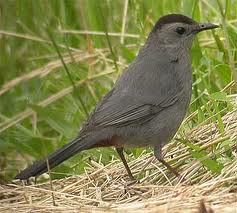
imagesSometimes spring clicks into place for me in an unexpected but thoroughly satisfying way. One early April day while I was in our woods engaged in the ongoing battle with garlic mustard and honeysuckle, I heard a familiar, lively song. I laughed with pleasure. It was our first spring catbird! I hadn’t realized how much I’d missed him. Dapper in his gray suit and black cap, he sang cheerful encouragement while I pulled up invasive plants.

Then a downy woodpecker complained about our empty suet feeder, so I lugged my bagful of weeds to the garage and brought out some suet. The little downy hung back. The first bird to enjoy the feast was my blithe companion, the catbird.

“Welcome home,” I told him. “Now, it’s Officially Spring.”

Introducing myself

Image

Where I Live:  Grew up in northern New Jersey, went to college in Kentucky, spent some time in the Marshall Islands, and moved to Maryland in 1968.

 How I live:  With a great companion named Lou Martin; we’ve been cohabiting since 1981. We have one television set, two computers, and thousands of books.

Family: Two sons named David and Gary, and four grandchildren named Annika, Zachary, Sophie, and Charlotte (in order of age). Lou has a daughter-in-law named Leah, and three grandchildren named Kiely, John, and Joseph. We share all the grandchildren–it’s great.

Favorite exercise: Walking in the woods.    Image

Favorite place to visit: the British Isles.

Pets: Three cats named Bastet, Dickens and Zeno, all black with white feet.

Favorite Authors for Adults: Charles Dickens, Lewis Thomas, J.R.R. Tolkien, Connie Willis, John Wyndham, John McPhee, Bernd Heinrich, Dorothy Sayers, Ivan Doig, Terry Pratchett.

Favorite Authors for Kids: Jane Yolen, Arthur Ransome, J.K. Rowling, Peter Dickinson, Rudyard Kipling, Susan Cooper, Katherine Paterson, Rosemary Sutcliff, Diana Wynne Jones.